


Sales
Manage accounts, pipeline and forecasts with agents that research prospects, prepare deals and monitor accounts.

Browse by topic
Latest from Diginine
Insights, case studies and updates from the Diginine team.
Service lines
Solutions
Show all solutions Solution
Saka Blancverse
Sales, stock, finance and marketing, plus an AI agent on WhatsApp, in one workspace. Explore solution
 Solution
Salesforce
One customer platform for sales, service, marketing and data, with AI agents built in. Explore solution
 Solution
Mendix
Build governed enterprise applications faster, from the first workflow to a reusable digital… Explore solution
One accountable partner, from strategy to operations.


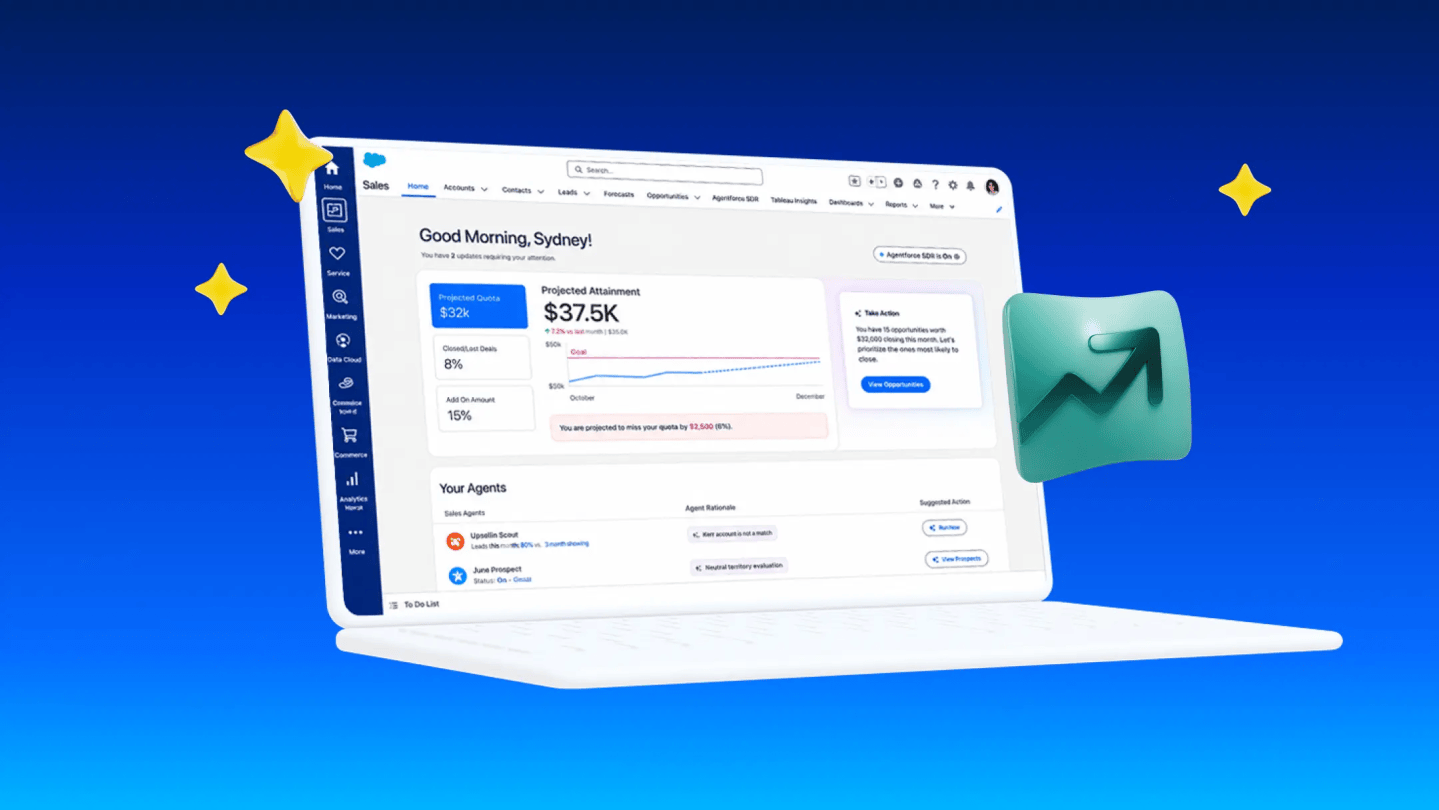
Give every team the same view of the customer and let AI agents take on the repetitive work. Diginine implements and supports Salesforce, starting with the process that matters most to you.
Salesforce is a cloud customer-relationship platform. It brings sales, service, marketing, commerce and the data behind them onto one platform, so that the people who talk to a customer, and the AI agents that assist them, all work from the same context.
At its core are the CRM applications your teams use every day, the Data 360 layer that unifies customer data, Agentforce for building and governing AI agents, and the Salesforce Platform for extending everything with low-code and pro-code tools. Around them sit Slack for collaboration, Tableau for analytics and MuleSoft for integration.
Because it is delivered as a service, new capabilities arrive continuously. The real work for most organizations is not switching features on, but fitting them to their own process, data and people, and that is where implementation experience matters.
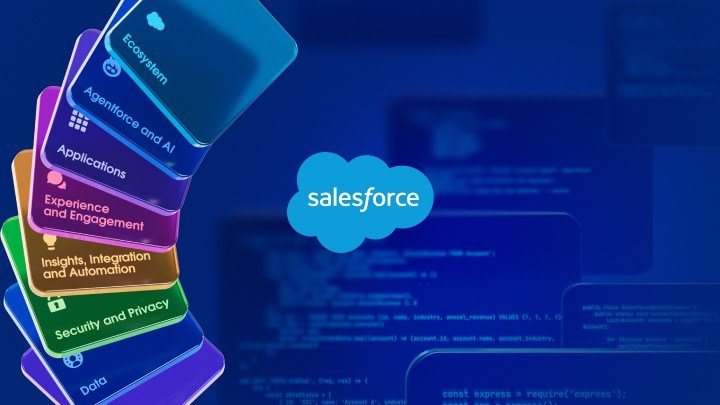
Salesforce groups its CRM applications by the job to be done. Start with one and add others as you grow.
Manage accounts, pipeline and forecasts with agents that research prospects, prepare deals and monitor accounts.
Handle cases, knowledge and every customer channel in one place, with AI agents for customers, service reps and supervisors.
Assemble campaigns, act on customer intent and adapt journeys continuously, using agents and unified customer data.
Connect ecommerce, point of sale and order management so every conversation can become a purchase.
Run pricing, quoting, contracting and billing across channels on the same platform as your CRM.
Equip mobile technicians to deliver service faster, with asset service lifecycle management and remote assistance.
The CRM works best when it is fed by trusted data and connected to the rest of the business.
Unify customer and enterprise data into trusted context for people and AI agents, without building heavy data pipelines.
Integrate applications, govern APIs and automate processes so customer experiences stay connected end to end.
Give every team trusted analytics and the ability to act at the point of insight.
Bring people, agents and CRM data together where teams already talk, for example sales insights and service work inside Slack.
Extend with low-code and pro-code tools, build portals and custom apps on your Salesforce data, and manage releases with DevOps tooling.
Discover and deploy partner agents, apps and expert services that extend what Salesforce does out of the box.
Official videos from Salesforce. They load from YouTube only when you press play.


Capabilities as Salesforce describes them. Which ones you need depends on your process, edition and data.
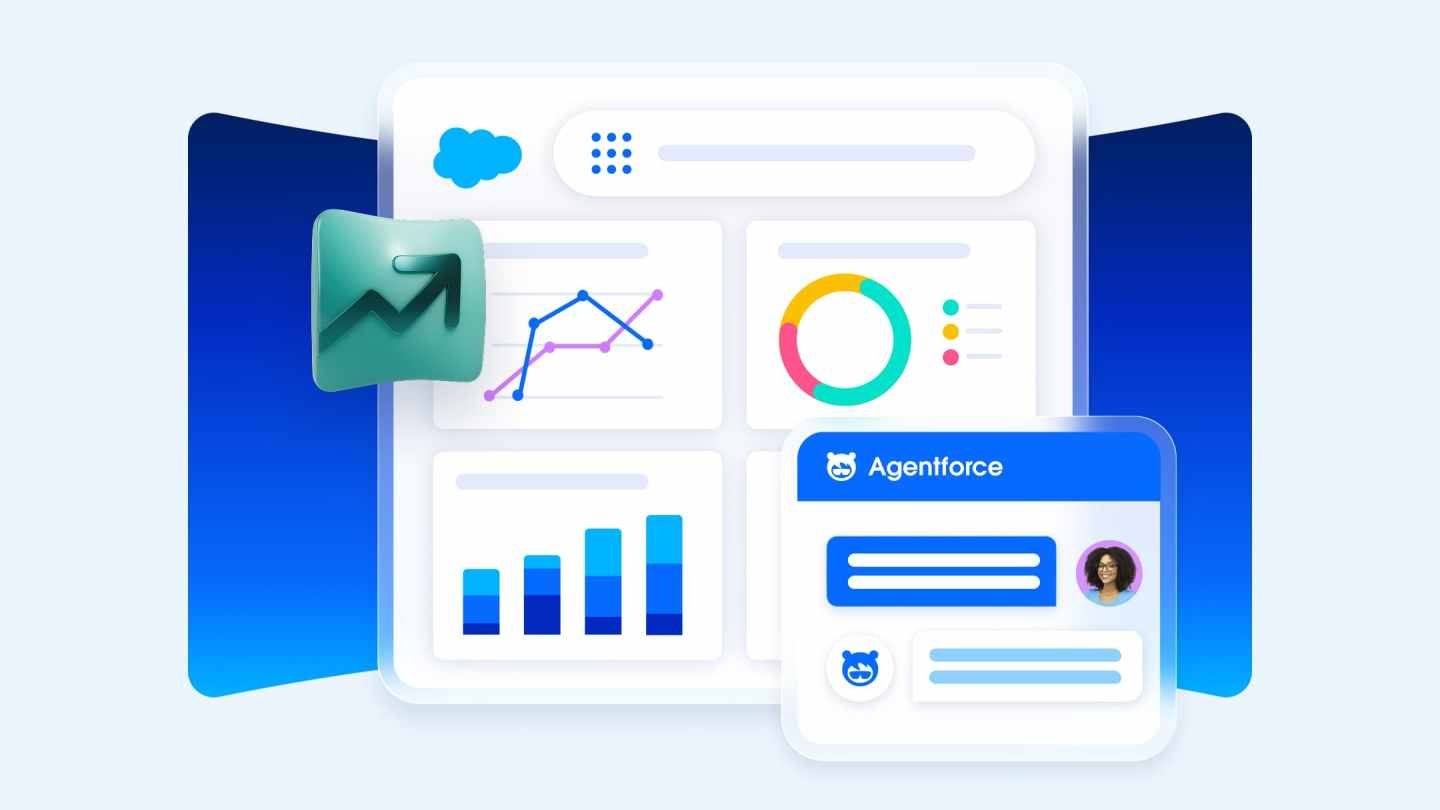
Agentforce is Salesforce's platform for building, deploying and managing AI agents. Salesforce describes agents that use large language models to understand a request, reason about the next step and act across web, phone and apps, escalating to a person when needed.
Agents are grounded in your CRM and Data 360 data and run within the guardrails you set, with human oversight where it matters. Salesforce states that agents can be built with Agent Builder, Flows, prompts grounded in enterprise data, MuleSoft connectors and Apex or JavaScript for custom logic.

Data 360, formerly Data Cloud, is Salesforce's data platform. It brings data from Salesforce clouds, third-party apps and databases into one view, and it can reach data in other platforms without copying it.
That unified context is what lets a service agent, a marketer and an AI agent all see the same customer. It is also the foundation Salesforce uses to ground Agentforce in verified business information.
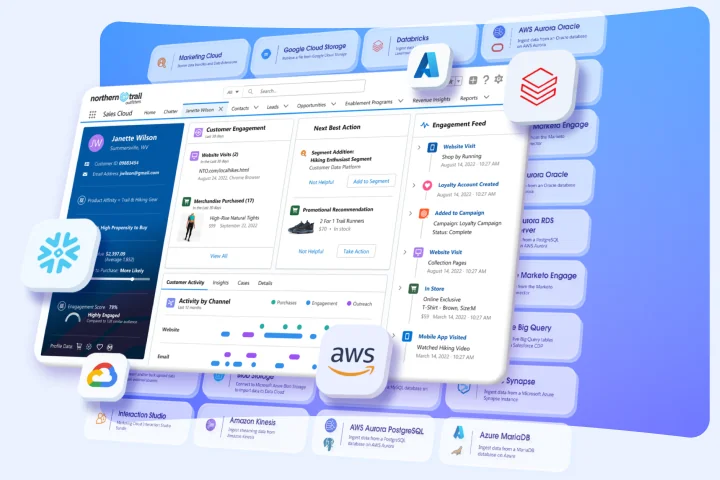
Common starting points. We help pick the one that gives your organization the clearest early result.
Challenge: deals live in spreadsheets and personal notes, so managers cannot see pipeline health or forecast with confidence.
With Salesforce: one pipeline, one account history and consistent stages, with agents handling research and preparation.
Typical integration: ERP, quoting, email and calendar, and Slack.
Challenge: requests arrive by phone, email, chat and WhatsApp, and nobody sees the whole history.
With Salesforce: cases and knowledge in one place, routing across channels, and AI agents that answer routine questions and hand over to people with the context intact.
Typical integration: telephony, messaging, order and billing systems.
Challenge: campaigns run on separate lists with little feedback from real behavior.
With Salesforce: unified profiles, segmentation and journeys that react to what customers do, linked to loyalty and commerce.
Typical integration: WhatsApp and messaging channels, commerce and loyalty platforms.
Challenge: internal IT and HR requests are handled over chat and email, with no tracking.
With Salesforce: requests resolved through one agentic platform rather than just ticketed, with knowledge shared across both teams.
Typical integration: identity, HR systems and collaboration tools.
Recent Salesforce announcements that matter for local deployments.
In July 2025 Salesforce extended its Hyperforce architecture to Indonesia, so products such as Data Cloud, Agentforce, Tableau and Marketing Cloud Next can store data in-country. This matters most in regulated sectors.
In December 2025 Agentforce Service and Employee Agent became available in Bahasa Indonesia, so agents can serve customers and colleagues in their own language.
In July 2026 Salesforce brought Agentforce capabilities into its Salesforce Suites (Free, Starter and Pro) at no additional cost, together with Slack CRM in the Business+ plan.
We start with one process and one team, prove it, and build outward on the same foundation.
Choose the process that matters most, map the people and systems around it, and agree what should measurably improve.
Define objects, fields, ownership, roles and the single customer view before configuring anything.
Set up the chosen applications, automation with Flow, and where it fits, the first agents and their guardrails.
Connect ERP, billing, messaging channels such as WhatsApp, identity and other systems through APIs you can monitor.
Train a first group, measure before and after, and refine the process and the data from real use.
Keep the platform healthy with administration and support, then add clouds, data and agents when the foundation is ready.
Salesforce is part of Diginine's Business Application service line, within CRM and sales automation: CRM, salesforce automation, loyalty and commerce, WhatsApp automation and AI chatbots, delivered together with partners such as Jalin.
Our talent and managed-services line also places certified specialists with customers. For a B2B health and life insurer, an on-site Salesforce administrator handles Level-0 support, integration monitoring, structured escalation and weekly reporting.

Start with the team and process where better customer context would help most, often Sales or Service. Data 360, Slack, MuleSoft and Agentforce can be added as the foundation and your needs grow.
No. Agents are only as good as the data and process they work on. We usually get the CRM records and activity habits right first, then start with internal tasks before agents that speak directly to customers.
Yes. Typical integrations cover ERP, billing, messaging channels such as WhatsApp, identity and data platforms, through APIs and MuleSoft. The right design depends on your systems of record and volumes.
Salesforce announced in July 2025 that its Hyperforce architecture was extended to Indonesia for products such as Data Cloud, Agentforce, Tableau and Marketing Cloud Next. Which products and regions apply to your edition should be confirmed during design.
Salesforce announced Bahasa Indonesia support for Agentforce Service and Employee Agent in December 2025. We help you confirm what is available for the products and editions you plan to use.
Salesforce offers editions aimed at smaller teams, and in July 2026 it brought Agentforce capabilities into its Suites editions. The right scope is a modest first use case rather than a large rollout.
Salesforce describes agents running within guardrails, with observability and human oversight. We add the practical side: clear scope per agent, tested instructions, review of agent activity and an owner for each agent.
Yes, Salesforce evolves its products often. For example, Data Cloud is now called Data 360. We keep this page and your implementation aligned with the current product names and capabilities.
Tell us where customer information gets lost today. We will help scope a first Salesforce use case that is worth proving.
Talk to Diginine
Diginine delivers integrated IT solutions from consulting and system implementation to fully managed services.