


See the whole estate
Discover networks, cloud assets and DNS records across environments, including hidden, stale and conflicting resources.

Browse by topic
Latest from Diginine
Insights, case studies and updates from the Diginine team.
Service lines
Solutions
Show all solutions Solution
Saka Blancverse
Sales, stock, finance and marketing, plus an AI agent on WhatsApp, in one workspace. Explore solution
 Solution
Salesforce
One customer platform for sales, service, marketing and data, with AI agents built in. Explore solution
 Solution
Mendix
Build governed enterprise applications faster, from the first workflow to a reusable digital… Explore solution
One accountable partner, from strategy to operations.


Infoblox brings DNS, DHCP, IP address management and DNS-layer security into one operating model—so teams can move faster without losing visibility, resilience or control. Diginine helps you modernize it without a disruptive big-bang migration.

Every application starts with a name and an address. DNS connects names to services. DHCP gives devices the addresses they need. IPAM records which networks and addresses exist, who owns them and how they may be used. Together, they are DDI—the foundation beneath application delivery.
The trouble begins when that foundation is split across spreadsheets, Microsoft DNS, data-center appliances, public-cloud consoles and external DNS providers. Cloud teams can deploy quickly, but network teams discover overlapping address space later. Old DNS records stay behind. Troubleshooting becomes a search across tools, tickets and people.
Infoblox replaces that fragmented operating model with authoritative data, consistent policy and automation across on-premises, public cloud, private cloud and external DNS. The same DNS layer can also become an early security control, seeing destinations that endpoint tools and firewalls may miss.
The value is not another network console. It is fewer handoffs, cleaner data and faster decisions across NetOps, CloudOps and SecOps.
Discover networks, cloud assets and DNS records across environments, including hidden, stale and conflicting resources.
Turn IP allocation, DNS records and DHCP changes into governed workflows and APIs instead of manual tickets.
Run critical DNS and DHCP services with enterprise-grade availability across data centers, branches and cloud regions.
Use Protective DNS and predictive intelligence to block malicious infrastructure before a connection reaches its target.
Start with the pressure point that matters most, then extend the same foundation as your network and cloud operating model matures.
A SaaS-managed control plane and API for DNS, DHCP and IPAM across on-premises, public and private cloud, and external DNS.
Manage public and private zones across NIOS, NIOS-X, Microsoft DNS, Route 53, Azure DNS, Google Cloud DNS, Cloudflare and Akamai.
Apply consistent DHCP visibility and management across distributed environments while preserving local service delivery.
Define address policy centrally, prevent overlaps and give cloud teams governed access to unique address space through native tools and APIs.
Continuously discover and analyze assets across hybrid, multi-cloud environments to expose blind spots, stale records and compliance gaps.
The resilient core for authoritative DNS, recursive DNS, DHCP and IPAM, connected through Infoblox Grid and available as physical or virtual deployment.
Cloud-native DNS and DHCP protocol services delivered as physical, virtual or as-a-service options and managed through Infoblox Portal.
Protective DNS, behavioral analytics and predictive threat intelligence for users, workloads, remote devices, IoT and OT.
AI-assisted prioritization and enriched DNS context to reduce alert noise and move analysts from detection to investigation faster.
Universal DDI separates management from service delivery. Infoblox Portal provides the shared control plane, policy and API. DNS and DHCP continue to run where they make operational sense: NIOS in the core, NIOS-X in cloud and distributed locations, or third-party services already embedded in your environment.
That matters because modernization does not have to begin with a wholesale replacement. A team can first establish visibility and governance, bring existing DNS zones into a common view, then move selected services when there is a clear operational reason.
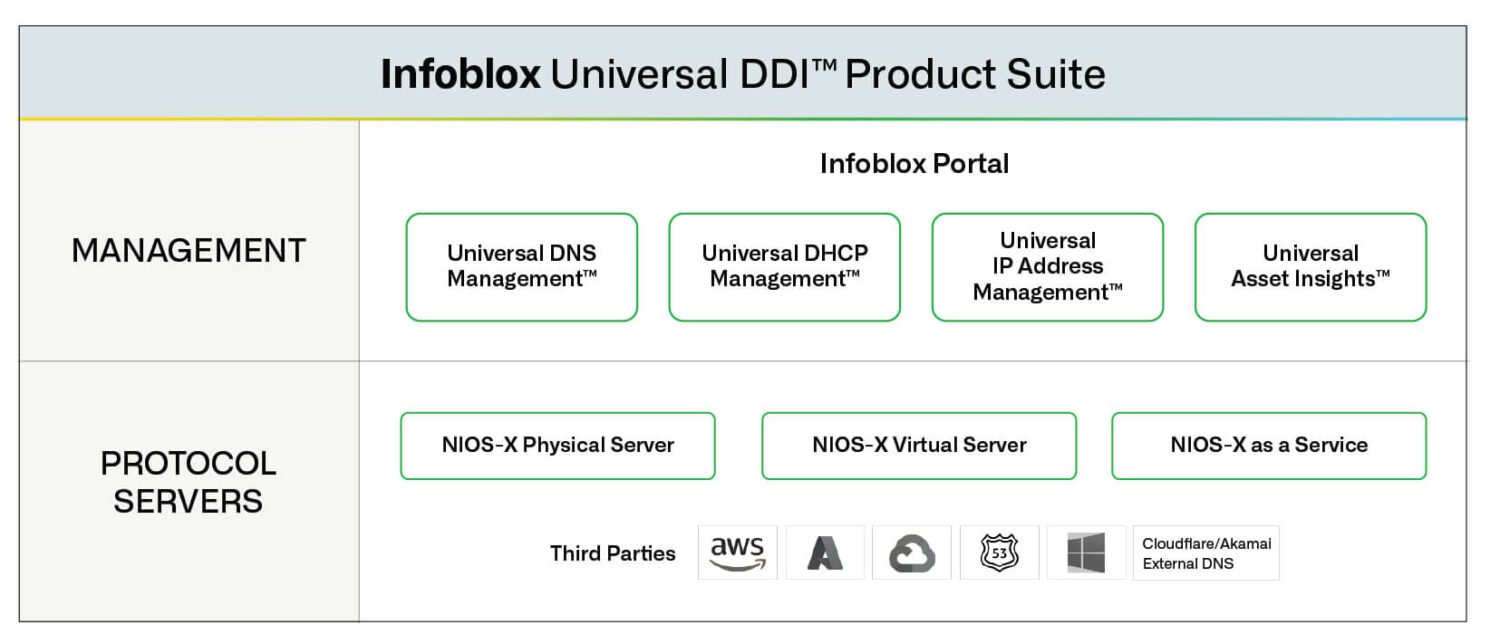
Each layer solves a different problem, but the value compounds when they share authoritative network and asset context.
For NetOps and CloudOps
Manage DNS zones, DHCP services and address space through consistent policy and workflows. Cloud teams retain the speed of their preferred consoles, CLIs and infrastructure-as-code tools while the organization keeps a governed source of truth.
This is where fragmented cloud and on-premises DDI becomes one operating model rather than a collection of integrations.
For operations, security and governance
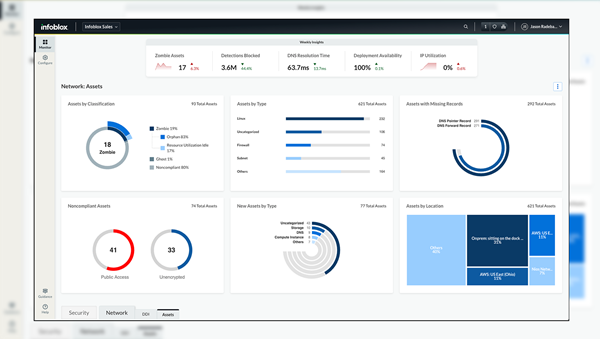
Universal Asset Insights discovers assets and their network context across hybrid, multi-cloud environments. Teams can surface unmanaged assets, stale or orphaned DNS records, overlapping address space and policy exceptions without waiting for a manual inventory exercise.
The result is a living view of the estate, not a spreadsheet that was accurate on the day it was exported.
For critical infrastructure teams
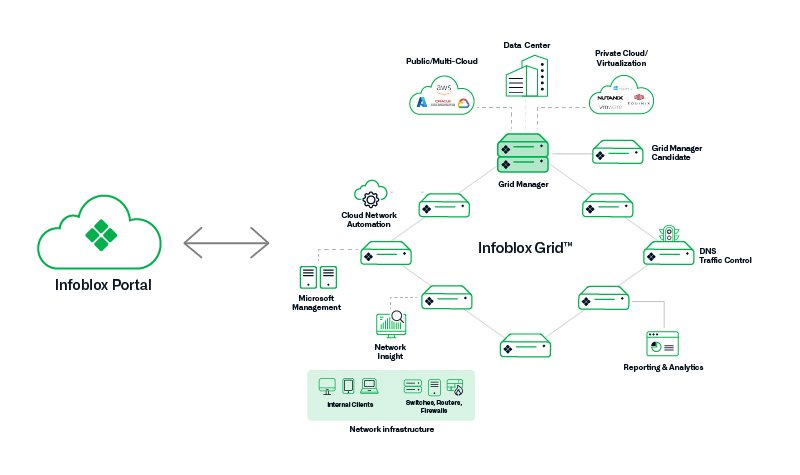
NIOS DDI and Infoblox Grid provide the resilient core for enterprise DNS, DHCP and IPAM. Services can be deployed on physical or virtual appliances and in major public clouds, with architecture patterns for high availability, distributed operations and centralized governance.
NIOS-X extends protocol delivery into cloud-native and distributed environments while remaining visible through Infoblox Portal.
For SecOps and incident response
Threat Defense analyzes DNS activity and applies predictive intelligence, behavioral models and machine learning to identify suspicious infrastructure, DNS tunneling, DGAs and lookalike domains. Enriched user, device and network context helps analysts understand who connected, from where and to what.
Security Workspace and Infoblox IQ help reduce large event volumes into a smaller set of actionable investigations.
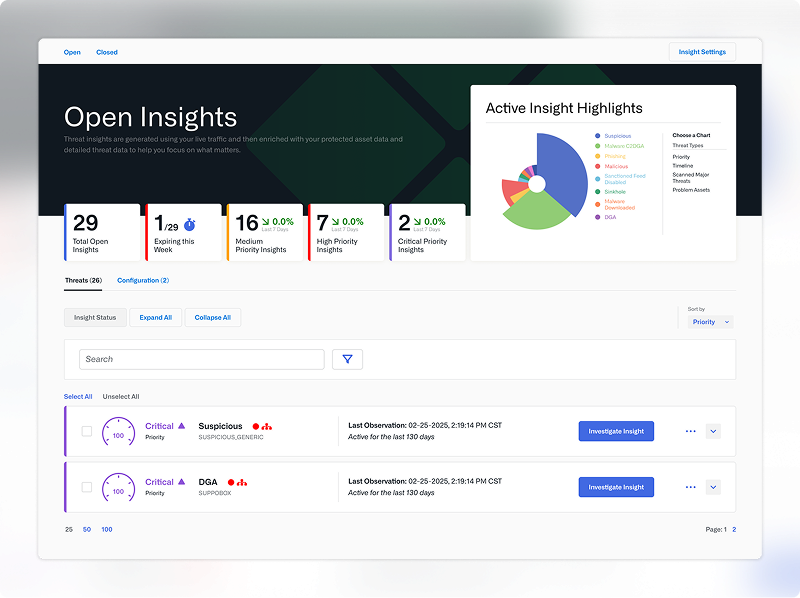
Nearly every device asks DNS where to connect before the connection begins. That includes servers, cloud workloads, remote users, IoT and many OT devices that cannot run a conventional endpoint agent.
Infoblox Threat Defense uses that vantage point to block known and emerging malicious destinations, detect suspicious DNS behavior and add asset context to investigations. A detection-first engagement can show what your current controls are missing before blocking policies are introduced.

The strongest business case usually starts with one operational bottleneck, not with a platform-wide replacement project.
Allocate non-overlapping networks, automate records and give teams one view across AWS, Azure, Google Cloud and the data center.
Build resilient critical services, controlled change, delegated administration and auditable address ownership for banking, government and essential services.
Discover connected assets and extend agentless DNS-layer protection to devices that traditional endpoint controls cannot cover.
Apply consistent DNS and security policy across headquarters, branches, campuses, remote users and cloud workloads without losing local context.
A safe program makes the current state visible first, proves the target design in a bounded scope, and migrates services in controlled waves.
Inventory DNS zones, resolvers, DHCP scopes, address blocks, cloud accounts, external DNS, integrations, owners and operational dependencies.
Define the target control plane, service placement, availability model, IPAM hierarchy, delegation, naming standards, security policy and rollback approach.
Choose a representative but contained site, cloud account or service. Validate workflows, automation, observability and failure handling with real users.
Connect identity, cloud platforms, Microsoft, ITSM, SIEM/SOAR, network automation and infrastructure-as-code pipelines where they improve the operating flow.
Move zones, scopes and address data in waves with clear validation, coexistence and rollback checkpoints. Avoid a single all-or-nothing DNS event.
Measure data quality, policy exceptions, automation adoption, service health and DNS security findings; then extend to the next environment or use case.
Diginine brings network, cloud, security and integration work into the same delivery plan. We help translate a broad Infoblox portfolio into a practical target architecture, then prove it against your real zones, address data, cloud accounts and operational constraints.
An engagement can begin with a DDI health assessment, an asset-visibility pilot, a Threat Defense detection workshop, a NIOS modernization or a phased hybrid multi-cloud program.
DDI combines DNS, DHCP and IP address management. DNS connects names to services, DHCP assigns network configuration to devices, and IPAM maintains the authoritative record and policy for address space. Managing them together reduces manual reconciliation and gives changes better context.
No. Universal DDI is designed to manage services across Infoblox, Microsoft, public-cloud and external DNS environments. A phased model can establish visibility and governance first, then move selected services only where the operational case is clear.
Universal DDI provides the cloud-managed control plane, shared visibility, policy and API across environments. NIOS DDI delivers resilient DNS, DHCP and IPAM services and remains a common core for enterprise networks. They are complementary rather than mutually exclusive.
Infoblox documents support for managing Amazon Route 53, Microsoft Azure DNS and Google Cloud DNS, alongside NIOS, NIOS-X, Microsoft DNS and external DNS services such as Cloudflare and Akamai. The exact integration scope should be validated against your services and operating model.
Yes. Microsoft environments can be brought into a unified management model rather than replaced immediately. The right long-term design depends on service criticality, ownership, automation requirements and the level of resilience or security you need.
Protective DNS works at the resolver layer and can cover agentless devices, including many IoT and OT systems. Endpoint options are also available for roaming users and devices where direct DNS forwarding is appropriate.
Begin with discovery and dependency mapping, design coexistence and rollback, lower TTLs where appropriate, validate data before cutover, and migrate in waves. Monitoring and explicit acceptance criteria are more important than moving quickly.
A focused assessment or pilot is usually best: one site, one cloud account, one DNS domain group, an asset-discovery scope, or Threat Defense in detection mode. Diginine can define the scope after a short architecture and operations workshop.
Share your current DNS, DHCP, IPAM, cloud and security landscape. We will help identify a first Infoblox use case that is valuable, measurable and safe to prove.
Talk to Diginine
Diginine delivers integrated IT solutions from consulting and system implementation to fully managed services.